
How far is the journey to a free and fair election?
Sharmeen S Murshid, election analyst
Since independence, Bangladesh has had a long history of violent elections. Democracy as an institution has experienced a steady decline after subsequent military rules in the 1970s and 80s. It continued to suffer even after the fall of the longest-running dictator in October 1990 as following the restoration of democracy the parties assuming political power through elections began to undermine the electoral process fearing defeat. The best example of a peaceful transfer of power in Bangladesh was after the elections of 1991 and 2008; the only example of an elected government completing the full term was in 2001.
The elections in 1991, 1996, 2008, 2014, and 2018 have one particular feature in common – the unwillingness of civil governments to maintain the democratic processes so that a peaceful transfer of power would be possible. A qualitative difference has been observed in the electoral process when elections were held under a caretaker government. During elections held under subsequent elected governments, the same process has been subject to considerable manipulation.
The malpractices that have marred the electoral process over the years have also become standard political norms in Bangladesh. When an election officer stamps a ballot paper, or non-voter votes or even a political leader intimidates the voters or breaches the Representation of the People Order or RPO and the Code of Conduct (as has been witnessed in the recently held local elections between 2016 and 18), such breaches of laws and regulations are often viewed as minor irregularities in Bangladesh. The authority may not disqualify the election as ‘unfree and unfair’. The question is how much irregularity is permissible to qualify a fair election? Who sets the standards? How many distortions of truth make a lie? How many deaths make for a violent election? How many times must the members of parliaments and election officers breach the code of conduct before we can say the system has
collapsed, before the Election Commission musters the courage to declare the elections null and void?
These were questions Sharmeen Murshid, the CEO of Brotee, asked herself exactly 14 years ago, in 2004 to be precise, while observing the parliamentary by-elections under the then-elected government of Bangladesh Nationalist Party. The questions she faced were as follows: Is the EC free to function neutrally? Will observers monitor elections freely? Will political parties abide by the Code of Conduct and the RPO? Will we have a ‘less’ unfree and ‘less’ unfair election?
The scope for election observation has shrunken over the years. Compared with 2008, today there will hardly be any international observers given that many have not received visas (ANFREL) and clearances (a downsize from 593 to less than 100). National observers will also be very limited due to a lack of funds (as the international community has shifted priorities) and a lack of permission for a larger observer group (a downsize from more than a hundred thousand to less than 20,000).
Observers and media are strictly regimented by the EC, hence, unlike in 2008 when many national and international observers were present, there will be fewer eyes to watch over the electoral process now. Good Governance: Monitoring electoral process Brotee has been monitoring the governance of the electoral process since 2001 and has acquired a reputation for being forthright and politically independent in its views and in her commitment to objectivity to establish democracy, voting rights of the people, and a sovereign electoral commission, as the first move towards participatory democracy. A series of successful election monitoring activities has led Brotee to become a well-recognised election watchdog agency while S Murshid’s activism and reputation as a social researcher as
well as a political analyst of the electoral process for media, generated huge media interest in Brotee’s involvement in monitoring the election process.
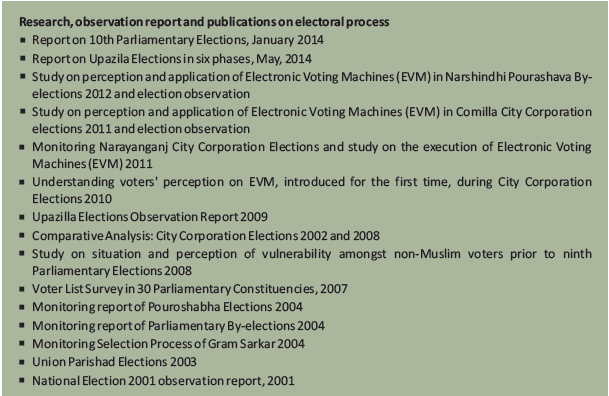
1. Brotee has monitored and published findings on every national and local election since 2001.
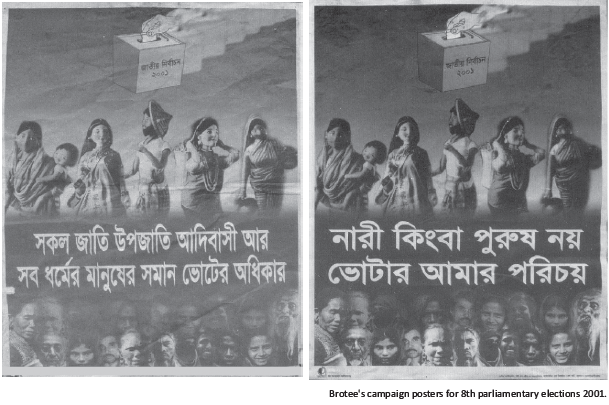
2. Brotee deployed 20,000 observers and observed the 2001 national elections, and was the first Election Observer Group to correctly identify the pre-election and election-day violence on minority non-Muslims, whereas most other observers, took a partisan view and chose not to objectively witness the
reality (Brotee press statement, 2001). It was only later that the international observers and media confirmed the findings. By then, it was too late to make any amends. The elections were not free of violence though they were accepted by the public and the media.
3. In 2001, when election monitoring was limited to only a one-day quantitative election observation, Brotee introduced the long and short-term, along with qualitative and quantitative research approaches to election monitoring.
4. Brotee introduced simultaneous long-term and short-term observation, integrating quantitative data with qualitative data, at a time when election observation was limited to election day observation and quantitative data only and contributed to the development of the election monitoring methodology making it more research-based and reliable;
5. In 2006-7, Brotee conducted, in a consortium with PPRS, Unnayon Shammonoy, and The Hunger Project) the largest survey in the nongovernment sector in Bangladesh: ‘the voter list survey in 30 constituencies’ where 75 lac voters were interviewed on a census basis. This combing operation led to the identification of 1.4 crore ineligible voters in the voter list. Later this finding was also confirmed by the EC when preparing a new voter list. This study confirmed that the voter list had a huge error. The study had a far-reaching impact on electoral policy and electoral politics in Bangladesh. It led to the initiative for a new voter list with photos.
6. Sharmeen Murshid, on behalf of Brotee, has undertaken several comparative analyses of the electoral process over the past ten years. Her research also extended to the study of voter perceptions of the Electronic Voting Machines, first introduced in the lections of 2015. She has also periodically studied the ‘security perception of vulnerable voters’ as an indicator of the qualifying electoral environment.
7. Advocacy and campaigns for voter awareness and a strong independent Election Commission; presented observation and study findings to the media, political parties civil society, and the Election Commission.