

About Brotee
Brotee, founded by sociologist Sharmeen Murshid, is a synergy of research and practice at the grassroots. The organization emerged in 1992 as a women’s consultancy firm, as a company for social change, facilitating participatory capacity in development in Bangladesh. In 2001, Brotee Samajkalyan Sangstha, a not-for-profit civil society entity was established to take participation to the grassroots to facilitate community vigil and governance to protect human rights and begin an ‘inclusive’ and participatory process by way of an innovative application of a social model.
Today, in 2022, Brotee is a synergy of actions that together facilitate social business and development with the overarching aim to establish social justice while ensuring the well-being of the most marginalized and vulnerable communities that have no access to basic services. Brotee serves people who have long been deprived of their entitlements as citizens and whose human dignity is constantly at stake.
Brotee means “the committed ones” in Bangla and as a social organization, it is committed to building an inclusive participatory democratic society within an ecofeminist framework where nature, women, and men live in harmony, where diversity is respected and equality and social justice are fundamental values to be followed by all. Brotee’s vision is a happy Bangladesh, where children and women are safe and free to express their creative energy, where people can live a happy, fulfilling life, emboldened by Atma shakti or inner strength, living compassionately and in harmony with nature.
Brotee’s logo is half dark and half light. It is a reminder that opposites are complementary and the universe is an amazing life-giving fusion of opposites, a spectrum of positives and negatives. In line with an ecofeminist philosophical position, Brotee has set priorities and found pathways to restore social and ecological harmony.
Thus Brotee chooses to be a rights based organisation working to build village movements whose mission is to:
(1) protect, preserve and promote human dignity of the most marginal and vulnerable segment of society,
especially children, women, the ethnic minorities and the ultrapoor; (2) protect, preserve and promote a balance
between human life and the ecosystem and where ever it is threatened, especially when in the name of progress
humans cause damage to land, water and ecosystems;(3) through compassionate community governance.
Brotee’s work areas
Brotee works in selected areas in northern Bangladesh of greater Rajshahi where there is a large ethnic
population and in the southwestern coast of Shyamnagar, Gabura, the frontline of climate change crisis.
These are some of the most vulnerable regions in the country.
A picture of deprivation – a reality check
In the past 20 years Brotee has developed its own understanding of poverty and deprivation based on the
perception of people as well as the many reasons why child marriage is so deeply ingrained in our rural society
and why the poor are stuck in their cycle of poverty while vested interest groups continue the destruction of the
ecosystems.
When the crisis of existence of humans and nonhumans are deepening in the face of disappearing forest, dying
rivers and depleted groundwaters, Brotee chooses to work among the marginalised.
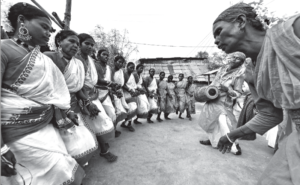
The urgency to protect the ethnic communities is acute. Statistics show in the past 20 years the population
decreased from 2% to 1%. Consequently, the rich cultural diversity of Bengal is also under threat.
Brotee’s outreach programmes:
The total number of people reached: 260 villages, 60,595 HH; Adibashi HH: 8027 (13% of the total stakeholders); of
this 27,874 are extremely poor (46%); total ethnic communities reached: 175 communities covering 17 ethnic
minority groups.
Fighting Deprivation – A Pathway to Harmony
Brotee’s working methodology is the Gonokriya Gobeshona or GKG-HRP Formula, Brotee’s participatory model
for social transformation. This method mobilises and organises villages into youth movements to protect the
rights of the vulnerable people. Collective action leads to community vigil and finally community governance.
Brotee”s village movements lead to community governance and the creation of SDG villages.