+880-1720243885
A Human Rights Framework for Social Change Gently blow the winds of change…
Start Date: 22 Sep 2026
End Date: 23 Sep 2026
Donate NowA Human Rights Framework for Social Change
Gently blow the winds of change…
GKG Youth Movement mobilizes adibashi and marginalized communities to recover land from land-grabbers.
A Rural Youth Movement where they start with what they know and build on what they have Youth Movement > Community Vigil > Informal Community Governance
It began with a sociologist, an idea, a concept and a trial in 3 villages. More trials and 200 repeated applications.
GKG HRP formula for Social Transformation is discovered
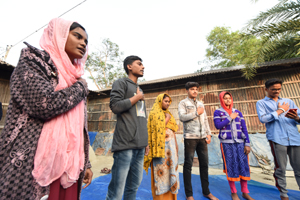
So, what is GKG HRP?
A participatory framework for social transformation
Gonokriya Gobeshona (GKG) aka Collective Action Research for the protection of Human Rights (HR) and Elimination of Poverty (P)
Gonokriya Gobeshona is a protocol of participatory actions whose repeatability and reproducibility unleashes collective youth energy in the most marginal, vulnerable, poor communities, leading to continuous community vigil and an organic community governance.
GKG is a holistic, integrative Gender and Ethnicity Responsive cross cultural tool used for social, economic and cultural harmony by creating a greater collective consciousness.
Gonokriya Gobeshona
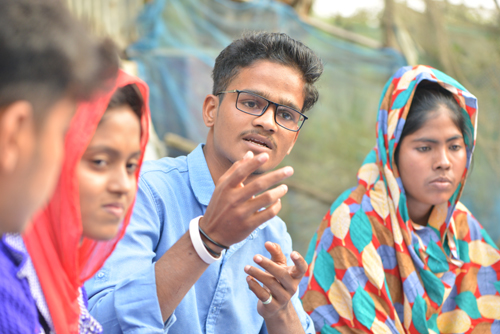
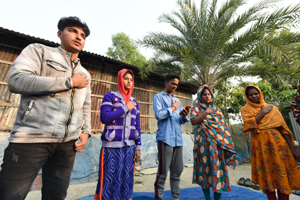
GKG is collective reflection and action of the poor, by the poor, for the poor. It is led by the peasant youth from
-Extreme poor
-Women
-Adibashi
-Differently Able
These are the Gono gobeshok (the ‘right’ researchers) and they are all between the age 13 to 25.
Gonokriya Gobeshona (GKG) Process: How does the instrument work?
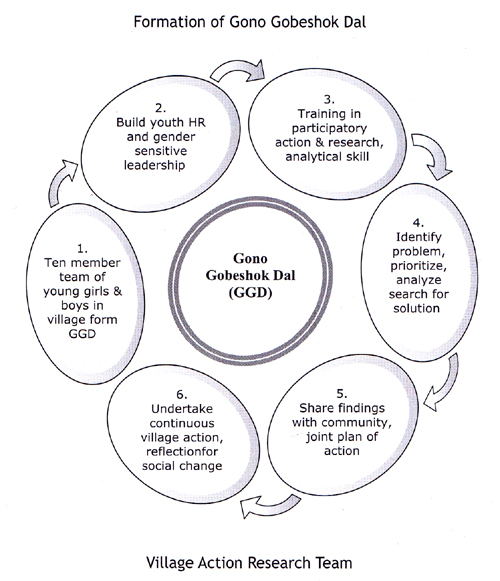
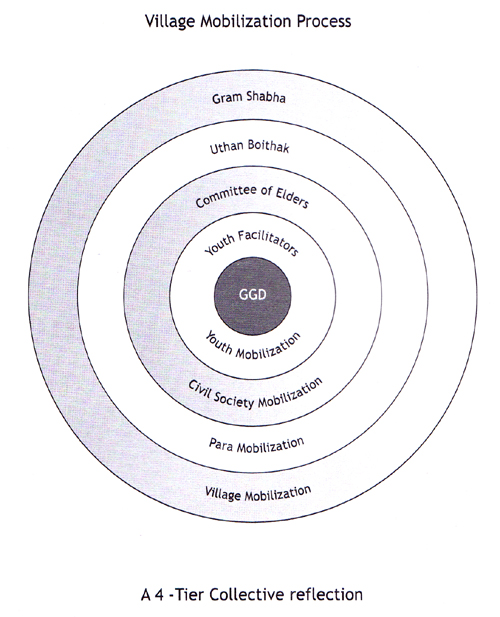
Brotee paves the way for women’s empowerment through this holistic and integrative system of implementing GKG.
Through this process, Brotee aims to achieve what it likes to call a Shukhi (happy) Village.
The impact of GKG is a shukhi village.
A shukhi village has 5 actions that lead to empowerment.
-Social
-Economic
-Political
-Environmental
-Spiritual
The Social Action – to protect the vulnerable
Safe village for all children & women
-No (gender violence) child marriage, dowry, eve teasing
-No addiction (related violence)
-Full school going village : no dropouts, community run schools
Access to safety net for the poor
-VGF, VGD, disability grants, muktijudhho grants etc.
-Duty Bearers - service to community improve (clinic, police, LG… )
Law is in application – formal & informal
-Community dispute resolution: shalish
-Barefoot law watchers – young volunteers
-Legal aid by CSOs and local government legal bodies (DLAC, ULAC)
The majority takes responsibility for protection of minority
The Economic Action – the poor acquire capital
Marginal Youth Groups (Gono Gobeshok - GGD)
-Savings, investments, self employment
Cooperatives of the poor
-Cooperatives of women, the landless, Adivashi, self help groups
Skill Training
-Vocational/Agricultural Training for skill development (e.g. tailoring, husbandry, cattle rearing, gardening, farming etc.)
-Technological Training: IT skill development
Community – CSO Joint Venture
-IT center, agro farming, marketing mechanism etc.
Increased youth employment
-In teaching, NGOs, GO, garment factory, marketing
-Total self employed and placed: 23405 (F-9362; M-14043)
The Political Action – leadership of the poor
New Youth Leadership
-The vulnerable poor, adibashi and women, comprise the new leadership
Community Governance
-People monitor (village HR status, poverty, injustice etc.)
-Village structures of the poor (e.g. GGD, Council of Elders, village committees protecting children and women, of landless, self help groups etc.)
-Increased representation in LG committees (school management, Union Parishad etc.)
Acting together
-Discourse of opposites: girls face boys; majority face minority
-Youth led community action make local police, administration, local representatives accountable, transparent & cooperative
The Environmental Action - to protect nature
Public Health/Sanitation
Full sanitation village
Access to safe drinking water (pond preservation, making river water potable, rain harvest, etc.)
Activation of community health clinics
Ensure health care & safe motherhood
Medical services for children and mothers & others
Food and nutrition
Agricultural extension service to farmers
Preserving local variety, promoting organic farming & organic fertilizers;
The GGD are Green defenders + River Protectors
Community vigil of rivers and forests.
People’s science & collective action to protect nature
The Spiritual Action – Inner strength and harmony in opposites
Realization of atma shakti: Inner Strength
Poverty is a state of the mind – this realization is the first step towards empowerment
The idea, not of poverty but of limitless human potential & possibilities, releases the power for transformation of the self & society
Unity in diversity & the art of co creation
Realization that opposites are complementary and hence gender and cultural discourse bonds, not conflicts
GGD is a multicultural, gender balanced youth group who pray together, seek together and create together
GKG seeks harmony in the Self, in Nature, in Society; seeks to transform the Self and Society to co – exist in harmony with nature and co-create a Shukhi Samaj!
© 2026 All Right Reserved. Brotee Samaj Kallyan Sangstha
Designed By